
TDCJ Roberts Release Paths
No TDCJ prison unit was identified in Roberts County. The statewide system still matters when a Roberts County criminal case results in a state sentence. A person can leave TDCJ on parole, mandatory supervision, or sentence discharge. Parole is discretionary supervised release approved by the Texas Board of Pardons and Paroles. Mandatory supervision is another form of supervised release governed by offense date and eligibility rules. Discharge means the sentence has ended, though another authority could still have a separate hold.
A local transfer to TDCJ is not a Roberts County community release. The sheriff's record should name TDCJ or a receiving facility, then TDCJ records become the best source for the state custody stage. Likewise, release from TDCJ does not erase the Roberts court file. The combined county and district clerk retains the judgment and sentence, while TDCJ holds incarceration history, classification, projected-date, and release processing records.
| Status | Meaning | Best confirmation |
|---|---|---|
| Currently incarcerated | Person remains in a TDCJ unit | Online Inmate Search |
| Parole or mandatory supervision | Prison custody ended but supervision continues | TDCJ history, IVSS, release certificate |
| Discharged | TDCJ sentence reached its lawful end | Incarceration history or formal records |
| Transferred | Custody moved, possibly to another authority | Transfer and receiving-agency records |
Search TDCJ Roberts Offenders
The TDCJ Online Inmate Search is designed for people currently incarcerated in TDCJ. Search by TDCJ number or SID when possible. Names can collide. Otherwise use surname, given name, sex, race, and approximate age as the form allows. Compare the unit, county of conviction, offense, sentence, and other identifiers before accepting a match.
Open the details page and note its access date. Location, parole review, and projected release information can change. Most important, a no-result does not verify a past release. The tool is not a full historical archive of discharged prisoners. It is strongest for the question, “Did a person leave Roberts County custody for state prison, and are they still there?”
- Start with the TDCJ or SID number from court or jail records.
- Search the official current-inmate tool and compare identity fields.
- Read the projected date as an estimate, not an actual release.
- For a past prisoner, request incarceration history by email.
- If supervision continues, verify the assigned parole office from the release papers.
The TDCJ offender information page explains these official routes. The broader Roberts County release search helps trace the county stage before TDCJ received custody.
TDCJ Search Screen Details
The official search screen is shown below through its TDCJ source. It should be used for present state custody and current projected information.
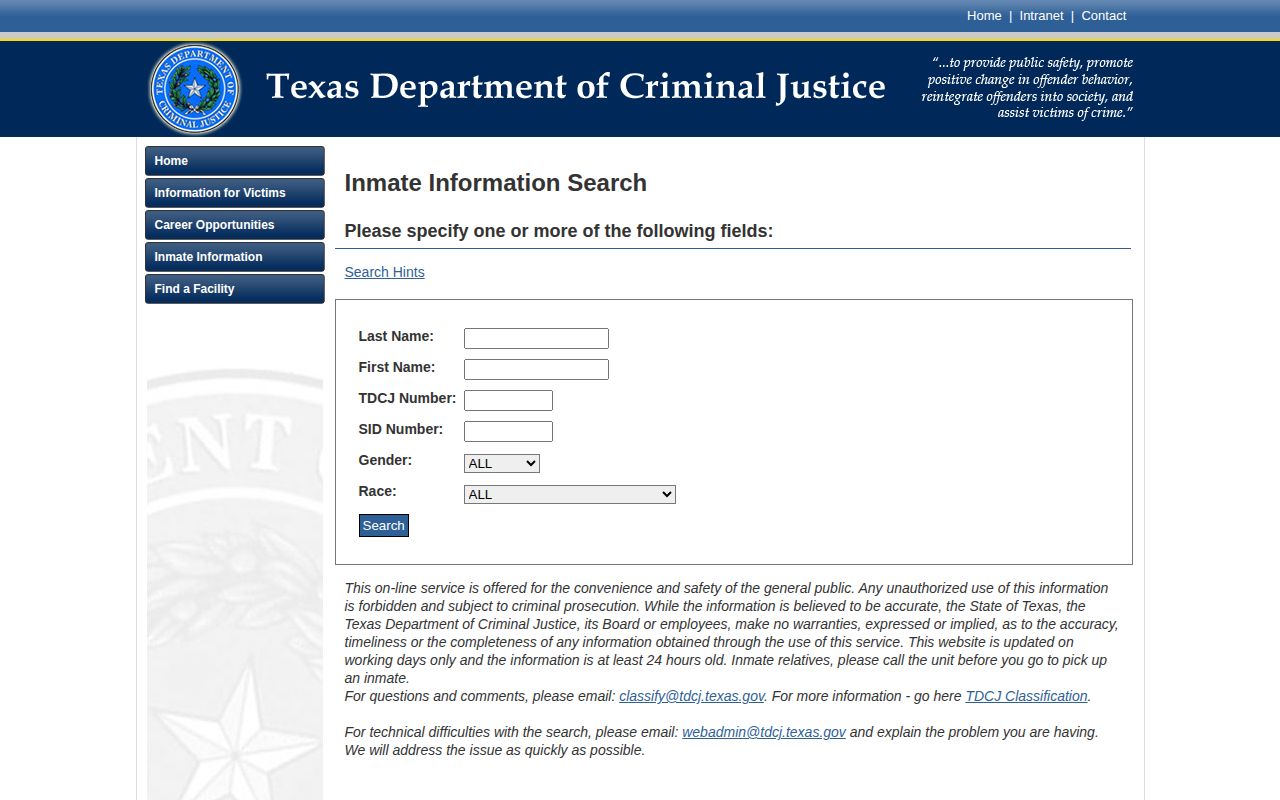
The screenshot does not turn the current-only tool into a released-person archive. When the person is absent, move to incarceration history rather than assuming the sentence ended.
| Field | Use | Caution |
|---|---|---|
| TDCJ number | Strong state identifier | Use seven digits in email requests |
| SID | Texas criminal-history identifier | Do not confuse it with a booking number |
| Location | Current unit or status context | Can change after transfer |
| Projected Release Date | Calculated possible prison exit | Not the actual release date |
| County and court | Helps match the Roberts case | One person may have several cases |
Request TDCJ Release History
For basic past information, email TDCJ's no-fee offender information service at pia@tdcj.texas.gov. Supply the full name and seven-digit TDCJ number. Without that number, give the exact birth date or approximate age and county of conviction. Ask for incarceration history, release or discharge date, release type, and any parole or mandatory-supervision status.
TDCJ says the service can provide the TDCJ number, location, current offense, county and court, incarceration history, and projected release date without charge. It does not provide photographs or Social Security numbers by this email route. A formal Texas Public Information Act request can seek existing release certificate, release location, and classification records, subject to legal exceptions.
PO Box 4017
Huntsville, TX 77342
Email: PIA@tdcj.texas.gov
Basic information: pia@tdcj.texas.gov
Published TDCJ cost examples include ten cents per paper page for fewer than fifty pages plus delivery. Larger work can involve personnel or overhead, and estimates above forty dollars receive special treatment. Ask for an estimate because the record and medium control the actual cost.
TDCJ Projected Versus Actual Release
TDCJ defines Projected Release Date as the date calculated by Classification and Records when a person is expected to leave incarceration if not paroled sooner. A parole eligibility date only marks when review may begin. Board approval is another stage. A scheduled date may appear after plan review, certificate preparation, eligibility checks, and a records audit. Actual release or discharge is retrospective proof that the custody event occurred.
Texas has no universal eighty-five-percent rule. Government Code Chapter 498 makes good conduct time relevant to parole and mandatory-supervision eligibility, not a promised cut to the sentence. Credits vary by classification and can be forfeited. Chapter 508 applies offense-, date-, sentence-, and finding-specific rules. Eligibility never guarantees Board approval.
- Projected date
- A calculated possible exit based on current legal and credit data.
- Scheduled date
- A release date posted after more processing, still subject to change.
- Actual release
- The completed physical release event.
- Discharge
- The legal end of the TDCJ sentence.
TDCJ Amarillo Release Processing
TDCJ identifies the Clements Unit in Amarillo as a regional release site. Geography alone does not prove that a Roberts County returnee will leave there. The person's Scheduled Release Location must come from TDCJ. The state says releases generally occur from 8 a.m. to 5 p.m. Monday through Friday except holidays, subject to change. Family should contact the unit before traveling.
Release processing can include civilian clothing, remaining trust funds, and a bus voucher when bus travel is used. These are state-prison logistics. They do not describe release from the Roberts County Jail. TDCJ Review and Release Processing checks the approved residence plan, statutory eligibility, discipline, programs, special conditions, and other criteria before a certificate is issued.
8610 Shoal Creek Boulevard
Austin, TX 78757
General section: 512-406-5449
Release processing status: 512-406-5202
After supervised release, the certificate controls reporting instructions. A directory page can identify a likely regional office, but it cannot replace the instructions issued to the person.
Match TDCJ Roberts Records
Identity matching is part of release verification. A Roberts County judgment may show a state sentence and county of conviction, while TDCJ assigns its own number and keeps the prison history. Compare the full name, birth information, TDCJ number, SID, offense, county, court, and sentence. One matching name is not enough. If an alias or corrected identifier changed a record, ask the records office to reconcile it.
Read the state history in order. Admission, unit transfers, Board review, release processing, actual release, supervision, and discharge are separate events. A release certificate proves the terms issued at departure. Incarceration history supplies the durable timeline. IVSS can add an event notice, and the parole office can address supervision. Together, those sources give a stronger answer than one changing projected date.
Public Record Search
Sponsored Results