
Roberts Release Dates Differ
Several dates can appear in a Texas custody record. A parole eligibility date is the first date a person may be considered under the applicable law. It is not a promised release. TDCJ's projected release date estimates an exit if the person is not paroled sooner and if the governing mandatory-supervision rules permit it. Maximum sentence date, also called maximum expiration, is the endpoint of the sentence calculation unless another legal basis changes custody.
A scheduled release date may appear after approval, plan review, certificate work, and a records audit. Actual release or discharge is retrospective. It confirms that the custody event happened. These terms should never be merged into one “out date.”
| Date | Meaning | What it does not prove |
|---|---|---|
| Parole eligibility | First possible consideration point | Approval or release |
| Projected release | TDCJ estimate under current rules and data | A fixed exit appointment |
| Maximum expiration | Calculated sentence endpoint | That no other hold exists |
| Scheduled release | Planned exit after processing advances | That physical release is complete |
| Actual release | Recorded completed custody exit | Release from every other authority |
Scheduled and projected dates look forward. The releasing agency's actual release entry confirms what occurred.
Find Roberts TDCJ Release Dates
A Roberts County conviction can lead to state imprisonment even though no TDCJ prison stands in the county. While the person remains incarcerated, use the TDCJ offender search. Search by TDCJ number or SID when possible, or use the name fields. Match the county and court of conviction, offense, sentence, location, and identifying details before reading any date.
- Determine whether TDCJ, a county jail, or another agency has custody.
- Collect the exact name and TDCJ or SID number.
- Open the TDCJ record and distinguish eligibility, projected, maximum, and scheduled dates.
- Check for parole-review information or a scheduled release location.
- After release, request incarceration history and actual discharge information from TDCJ.
The public search emphasizes current inmates and is not a complete released-person archive. The TDCJ no-fee email route can provide incarceration history and projected release information without charge, but it does not supply photographs. A formal records request can seek existing documents showing the actual release or discharge date, release type, release location, and certificate.
The official offender-search form shows the state fields used for a TDCJ lookup.
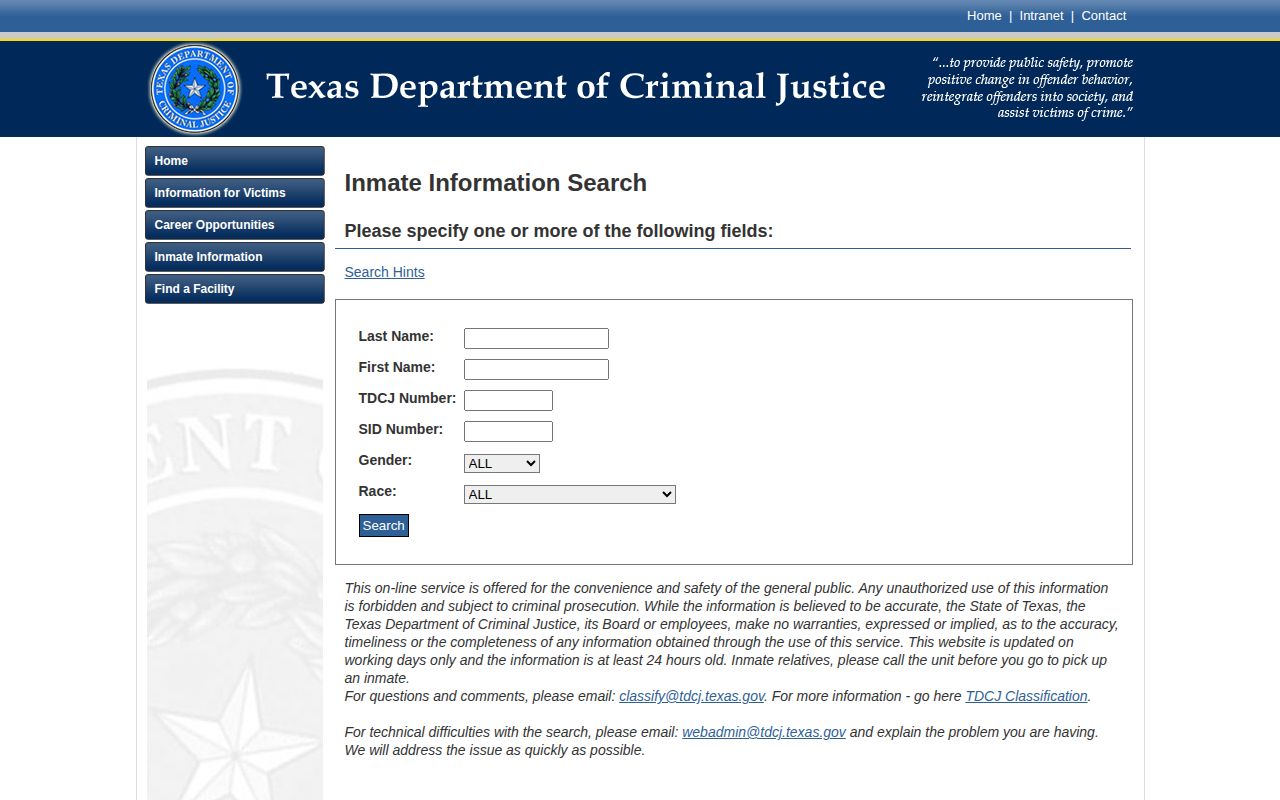
This state form applies to TDCJ custody, not a short Roberts County jail stay.
Roberts County Jail Dates
A pretrial detainee often has no fixed release date. Release can depend on bond, a personal-bond order, dismissal, another court order, or the resolution of holds. A person serving a county sentence may have a calculation based on the judgment, jail credit, and the sheriff's county good-time practice. Roberts County publishes no local credit table or operational policy.
Call the Roberts County Sheriff's Office at 806-868-3121 and ask whether release is authorized or physically complete, whether another hold exists, and whether the person is housed in another county. If housed elsewhere, obtain the receiving facility. Roberts may hold the arrest papers while the physical custodian keeps the day-to-day jail and release log.
For a county sentence, ask the combined clerk for the signed judgment, sentence, and jail-credit recital. Then request the sheriff's calculation or actual release entry. Do not apply TDCJ state-prison classifications to county time.
Texas Good Time Rules
Government Code Chapter 498 makes good conduct time relevant to parole and mandatory-supervision eligibility. It does not guarantee a simple reduction from the court sentence. Under Section 498.003, earning levels can depend on classification. Published levels include 20 days for each 30 served for trusty or Class I status, 10 for Class II, and none for Class III or while on parole or mandatory supervision. Program credits can also apply within legal limits.
Credits are a privilege. They may be forfeited, and classification can change. Adding the highest possible credit rate to calendar time will not produce a reliable release date. TDCJ Classification and Records applies the law and the person's actual record.
County good time is separate. Code of Criminal Procedure Article 42.032 permits a sheriff to commute county jail time for good conduct, industry, and obedience. No Roberts County table was found. Only the sheriff's calculation and release record can show what was applied locally.
No Texas 85 Percent Rule
Texas has no universal 85 percent truth-in-sentencing rule. A generic calculator using that percentage would be inaccurate. The controlling factors can include the law in effect on the offense date, the offense of conviction, findings or enhancements, sentence, jail credit, disciplinary credit, program requirements, and Board action.
Government Code Chapter 508 contains several parole formulas. The general Section 508.145(f) route uses actual calendar time plus good conduct time equal to one-fourth of the sentence or 15 years, whichever is less. Serious listed cases connected to Article 42A.054 or deadly-weapon findings generally require actual calendar time equal to one-half of the sentence or 30 calendar years, whichever is less, subject to minimums and specialized rules. Good time does not satisfy that flat-time requirement.
State-jail-felony confinement is not parole eligible under Section 508.145(e). Other specialized offenses and exclusions can use different rules. Ask TDCJ Classification and Records about the specific record rather than estimating from a headline percentage.
Why Roberts Dates Change
A projected date reflects the facts and decisions known when TDCJ calculated it. Later events can move it.
| Change | Possible effect |
|---|---|
| Credit earning or forfeiture | Changes eligibility or mandatory-supervision calculations |
| Classification or program status | Changes the credit record |
| Board approval or denial | Moves the expected release route |
| New court order or corrected jail credit | Changes sentence inputs |
| Detainer or another hold | Can prevent release to the community |
| Release-plan review | Can delay scheduling after approval |
A detainer is a request by another authority to hold or notify about the person. It can turn release from one agency into transfer to another. A parole approval also does not prove physical release. Review and Release Processing must complete its work, and approval may be withdrawn if new information arises.
Mandatory Supervision Recalculations
Mandatory supervision creates a Texas-specific reason for a displayed date to change. Section 508.149 excludes listed people and offenses. For an eligible offense before September 1, 1996, TDCJ definitions explain how calendar and good time can reach the sentence. For an eligible offense on or after that date, the Board must approve discretionary mandatory supervision.
A denial can move the displayed projected date to maximum expiration. A later approval can recalculate it earlier. That is why an old screenshot may disagree with today's official result. The TDCJ definitions page supplies the current meanings.
The official definition can be viewed in the TDCJ release-date reference.
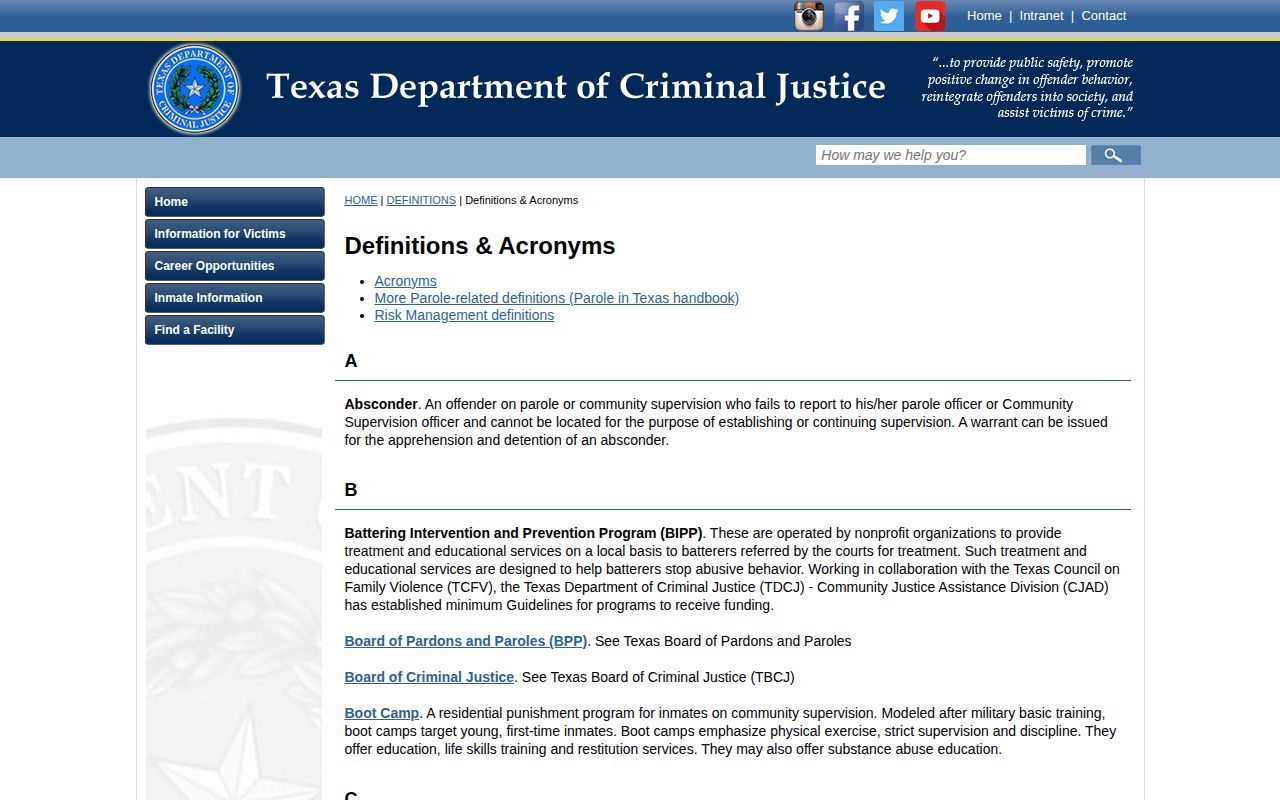
The definition explains a calculated state date, while the later TDCJ discharge record confirms the completed event.
Confirm Roberts Actual Release
After the projected date passes, check the releasing authority. For Roberts jail custody, request the booking and release entry, release authority, date and time, and destination. For TDCJ, seek incarceration history and documents showing actual release or discharge. A county release to TDCJ, USMS, ICE, or another county means custody continued elsewhere.
Use VINELink Inmate Search for prospective IVSS alerts and status changes, but preserve and verify each alert. Use the Roberts County released inmate search to reconcile sheriff, court, state, and federal sources. The final record should identify the exact agency whose custody ended.
Roberts Release Location Check
A scheduled release location is not always the place of conviction or the nearest state unit. TDCJ identifies the Clements Unit in Amarillo as a regional release site, but that does not prove a particular Roberts County prisoner will leave there. Read the current TDCJ detail and release documents. Family planning transportation should contact the unit before travel because scheduling and location can change.
TDCJ states that prison releases generally occur from 8 a.m. to 5 p.m. Monday through Friday except holidays, subject to change. Its process can include civilian clothing, remaining trust funds, and a bus voucher. Those practices do not apply to the Roberts jail. No local release hour, exit point, property rule, or waiting area was found. For a local release, call ahead and ask whether authorization is complete, whether another hold remains, where a ride should wait, and when property can be collected.
Roberts Sentence Input Records
A date calculation is only as sound as its inputs. The signed judgment identifies the sentence and conviction. Jail-credit provisions address time credited by the court. TDCJ applies the relevant law, offense date, offense classification, findings, credit record, and release route. A copied date without identifiers can belong to the wrong person or an older calculation.
Ask the combined Roberts County and District Clerk for the cause number, judgment, sentence, and jail-credit recital. Compare them with the TDCJ number and state record. If an input appears wrong, request the existing calculation record or contact TDCJ Classification and Records. A screenshot documents what appeared on one day but does not replace the current calculation.
Roberts Parole Date Limits
Parole eligibility and release are separate decisions. TDCJ identifies a case for review, an Institutional Parole Officer prepares a summary, and a three-member Board panel votes. Two matching votes make the decision. A favorable result can still require program completion, an approved plan, certificate work, and a final records audit. New information can cause withdrawal or rescission.
That sequence explains why a projected date, Board code, and scheduled date may not match. Use the official decision glossary to interpret the vote, then contact Review and Release Processing for processing status after approval. Confirm physical release from the final TDCJ record.
A Board result is distinct from maximum expiration. FI codes can authorize release when eligible, on a stated future date, or after a program. NR and DMS can produce later review or calculation changes. Read the complete code and current TDCJ status together. Do not convert a review month into an exit date.
After any scheduled date appears, check whether a detainer, another sentence, or a transfer remains. The end of TDCJ custody can lead to another authority rather than the community. The actual release or discharge record should name the event and, when recorded, its destination.
Preserve the date checked and the TDCJ number with each result. That small record makes later recalculations easier to explain and helps prevent a stale projected date from being presented as the final Roberts County release event.