
BOP Roberts Release Scope
The Federal Bureau of Prisons confines people serving federal sentences. Its Inmate Locator covers federal prisoners from 1982 to the present. That scope is different from the Roberts County Sheriff's Office, TDCJ, ICE, and the U.S. Marshals Service. A Roberts County arrest does not create a BOP record unless the person later enters the federal prison system. Likewise, a federal case can exist without BOP custody while the person is held before trial by USMS.
No BOP institution was identified inside Roberts County. The federal system appears as an escalation path when the sheriff's release entry, a federal docket, or another reliable record points to federal custody. Start with the agency that held the person at the relevant time. Do not search every federal system and treat silence as release.
| Authority | Custody stage | Public route |
|---|---|---|
| Roberts County Sheriff | Local arrest and jail custody | Call and request local records |
| U.S. Marshals Service | Many federal pretrial prisoners | Federal docket and district contact |
| Federal Bureau of Prisons | Sentenced federal imprisonment | BOP Inmate Locator |
| ICE | Civil immigration detention | ICE Online Detainee Locator |
Search BOP Federal Releases
Open the official BOP Inmate Locator. Identifier search accepts a BOP Register, DCDC, FBI, or INS number. Name search allows an optional age, race, and sex to narrow results. An identifier is safer when available because names may match several people. Compare the complete result before relying on it.
- Choose identifier search when a federal number is known.
- Otherwise enter the full name and narrow with supported identity fields.
- Compare name, register number, age, race, and sex.
- Read the release date, location, and status together.
- Check the federal docket and any receiving authority for what followed.
The BOP locator screenshot below comes from the official federal search.
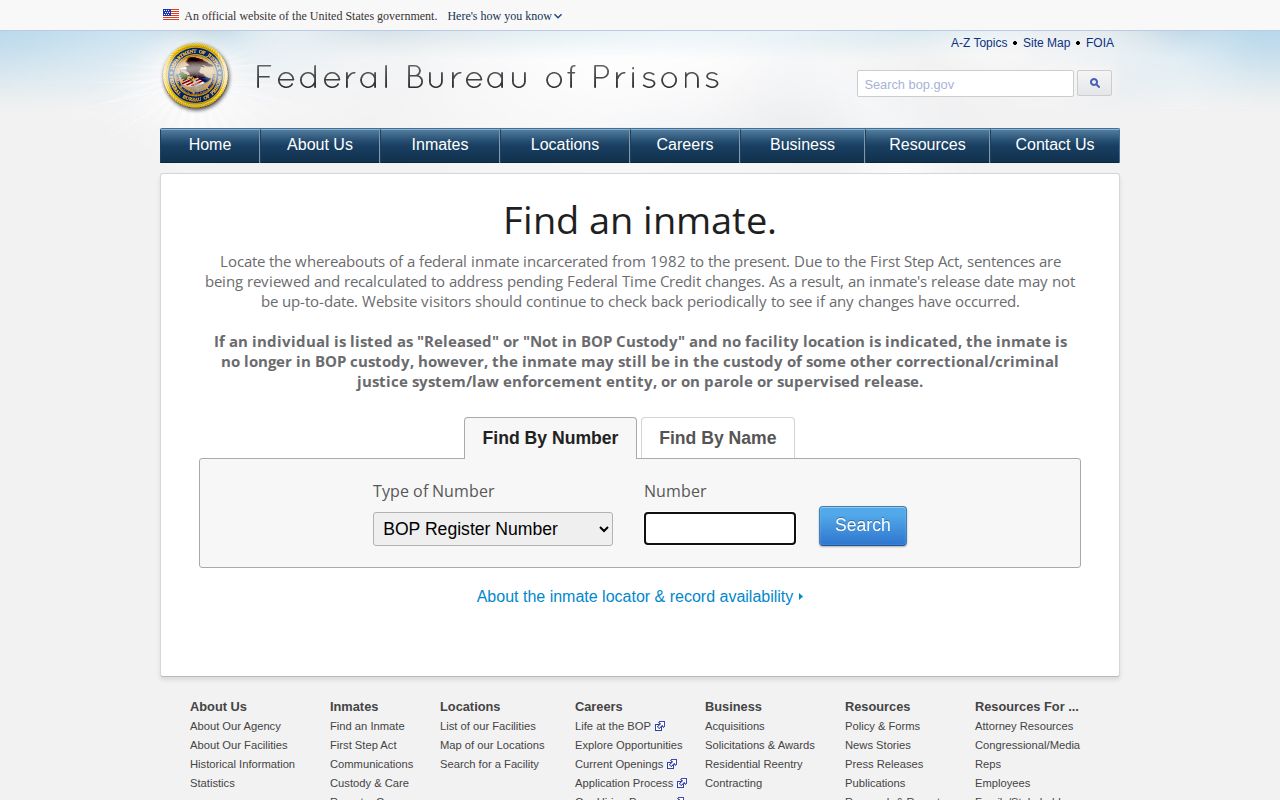
The screen can locate a federal record, but only the result and related court records can establish the specific release path.
Read BOP Release Results
A BOP result can display name, register number, age, race, sex, release date, and location. “Released” or “Not in BOP Custody” means that BOP no longer holds the person. It does not prove unrestricted freedom. The person may have entered state or local custody, ICE detention, or another institution. Federal supervised release can also follow incarceration without being physical custody.
A projected date can change as the sentence, earned credits, and First Step Act calculations are reviewed. Preserve the date when the locator was checked, and distinguish a future projected date from a past actual release date. If a result seems inconsistent with a court judgment, seek the sentence computation or release record rather than choosing the more convenient source.
- Release date
- The date shown by BOP for the end or expected end of its custody.
- Supervised release
- Federal court supervision after imprisonment, not continued BOP confinement.
- Detainer
- A basis for another authority to seek custody when BOP releases the person.
- Register number
- The federal identifier used to distinguish inmate records.
Request Federal Release Records
When the locator is incomplete, use the BOP Freedom of Information Act route. Identify the person and register number, narrow the date range, and ask for existing records that show actual release date, releasing institution, release status, and transfer destination. Federal privacy rules and exemptions can limit person-specific records. A focused request is easier to process than an open demand for everything.
For the court side, obtain the federal docket, detention or release order, judgment, and supervised-release terms. A judgment states the sentence but may not capture later credit calculations or the exact physical exit. The BOP record supplies the prison event. If another agency took custody, its intake record supplies the next event. That custody chain is the federal counterpart to matching a Roberts sheriff release entry with a receiving jail.
Nationwide federal prison system
Official locator: bop.gov/inmateloc
Records route: BOP FOIA
No local BOP street address belongs on a Roberts County page because no federal prison was identified in the county.
USMS Is Not BOP
The U.S. Marshals Service handles and transports many federal pretrial detainees. It may house them in local or contract jails. USMS has no public inmate locator equivalent to BOP's. A person can therefore be in federal custody yet absent from BOP because sentencing or designation has not occurred. Searching BOP alone can miss that stage.
Use the federal court docket to identify the district, case, detention order, release order, and counsel. Contact the responsible USMS district when appropriate. The restricted Prisoner Tracking System is not a public lookup tool. If a person is later committed to BOP, a locator record may appear after processing. If the court releases the person before BOP commitment, the federal docket and USMS records are more relevant than the BOP locator.
Timing also matters. A local booking sheet may name a federal hold before USMS completes transport. Later, a federal court can order detention, release, or commitment. BOP designation comes only after the sentenced-prison stage begins. Keep the date and authority beside every status so a current county answer is not confused with a later federal event.
If a Roberts County housing site held the person for federal authorities, request the local intake and physical release entries as well as the federal order. The jail can document when the person arrived and left. USMS or the court explains the federal authority. BOP becomes relevant only if the person entered its sentenced custody. This three-source approach closes gaps that no public locator can fill by itself.
Federal release conditions may appear in the court docket after physical detention ends. They do not change the historical fact of where the person was held. Keep supervision documents with, but distinct from, custody records.
Note: A local jail may physically house a federal detainee while USMS remains the authority responsible for the federal custody decision.
Federal Release After Roberts Custody
If a Roberts County jail record names USMS, ask when and to whom the transfer occurred. Then verify the federal case and custodian. A county “release to USMS” is a transfer, not release to the community. The Roberts record proves the end of the local hold, while the federal record proves the next step.
If BOP later shows release, check for a destination or detainer. ICE is a separate civil immigration system. TDCJ is a separate Texas prison system. A federal supervised-release term is managed through the federal courts and probation system. None should be inferred solely from the word “Released” on a BOP line.
The full Roberts County release records path helps identify whether the case began locally and which record names the receiving authority. The aim is not to merge systems. It is to link documented handoffs until the final custody event is clear.
Public Record Search
Sponsored Results