
Understanding Roberts County Releases
A Roberts County release means that one custodian stopped holding a person. It does not always mean the person walked into the community. The Roberts County Sheriff's Office may record release on bond, time served, completion of a county sentence, or transfer. A court order may authorize the change, while a receiving county, TDCJ, the U.S. Marshals Service, or ICE may continue custody.
That distinction controls the search. The sheriff's booking and release entries document the local physical exit. The combined Roberts County/District Clerk preserves the case result. TDCJ maintains state-prison history and supervision information. BOP and ICE use separate federal locators. A name missing from a live roster is only a lead because transfer, correction, and release can all remove a current-custody result.
Roberts County Release Paths
Local paperwork may use a short release code, an order reference, or the name of a receiving agency. Read the entry with the criminal docket and any destination field instead of relying on the word “release” alone.
| Release path | What it means | Next record |
|---|---|---|
| Bond or personal bond | Local confinement ends while the case continues. | Sheriff exit entry and court bond order |
| Time served or county sentence complete | The local confinement term has been credited or completed. | Release entry, judgment, and jail-credit calculation |
| Dismissal or acquittal | The case ends as the filed court record states. | Clerk's signed order plus sheriff's physical-exit record |
| TDCJ transfer | County custody ends but state custody begins. | TDCJ current search and later incarceration history |
| Another jail, USMS, or ICE | A different authority continues custody. | Receiving facility, federal docket, or applicable locator |
| Parole or mandatory supervision | State-prison confinement ends under TDCJ supervision. | TDCJ history, certificate, IVSS, and Parole Division |
Fields in a Roberts County Release Record
The useful record is tied to a specific booking. Ask for the jail card or booking sheet, the release event, and the relevant release-log line so identity and timing stay connected.
| Field | What it shows |
|---|---|
| Name and identifiers | The person attached to the event, often with date of birth or a booking number. |
| Booking and cause numbers | The link between jail administration and the related criminal case. |
| Booking date and time | When the custody episode began. |
| Release date and time | When Roberts or the physical custodian recorded the exit. |
| Release type or authority | Bond, order, time served, sentence completion, or another stated basis. |
| Destination or receiving agency | Whether the person entered another county, state, federal, or immigration system. |
| Charges and disposition references | The alleged offenses and pointers to court records, not necessarily the final result. |
A court judgment can prove conviction and punishment, and a dismissal can prove how prosecution ended. Neither alone proves the exact minute physical custody ended. Conversely, a jail exit does not prove that every charge ended. Reconcile both records.
Request Roberts County Release Records
The sheriff publishes no dedicated request portal, form, local fee schedule, or retention schedule. A narrow written request for existing records is the strongest route under the Texas Public Information Act.
- Identify the person by full name, date of birth if known, and a bounded booking date. Add the booking or cause number when available.
- Ask for the booking sheet or jail card, release date and time, release type or authority, destination if transferred, release-log entry, and booking photograph if needed.
- Send the request to the Roberts County Sheriff's Office, PO Box 66, Miami, TX 79059, or email bruce.skidmore@co.roberts.tx.us. Fax is 806-868-6521.
- Call 806-868-3121 during published office hours, Monday through Friday, 8 a.m. to 5 p.m., to confirm the preferred channel and receipt.
- Ask for an electronic copy and an itemized estimate above a limit you choose. Invite redaction of protected fields instead of withholding the rest when allowed.
For court proof, contact the combined Roberts County/District Clerk at 300 E. Commercial Street, Suite 104, Miami, TX 79059, 806-868-2341. Request the docket and named instruments such as a bond order, judgment, dismissal, or supervision-discharge order. If another jail physically housed the person, request that custodian's intake and exit entries too.
Texas Law and Roberts Release Records
Government Code Chapter 552 establishes the Texas Public Information Act. Section 552.021 states the general access principle, while Sections 552.221 and 552.301 address prompt handling and the process for seeking an Attorney General decision. An agency generally must take a defined response step within ten business days, but nonexcepted material is due as soon as reasonably possible.
Section 552.108 can protect specified law-enforcement information, although subsection (c) preserves basic information about an arrested person, arrest, or crime from that particular exception. Other law can protect juvenile, medical, victim, identifier, sealed, or expunged material. Public access is therefore record-specific, not automatic.
Why Roberts Uses Phone Verification
Roberts County does not operate like a high-volume jail portal. A Texas Commission on Jail Standards 2020–21 report listed three beds and average daily population zero. A June 2022 45-Day Report recorded one release in May and none in March or April. Those dated figures are context, not a current count.
The history explains why a person-level release feed may not exist here. It also makes a direct call more valuable. Ask the sheriff to distinguish a community release from an out-of-county placement, then obtain the existing entry that supports the answer.
Where Roberts County Actually Housed Them
The small local operation makes the receiving-facility question part of any accurate Roberts County release check. A November 2021 TCJS report counted two Roberts inmates housed elsewhere. That dated total does not identify the facility or the people, but it confirms that the arresting county and physical custodian can differ.
Ask Roberts for the arrest and transfer trail, then ask the named receiving jail for its intake and release entries. A Roberts County case number may remain the best bridge between the two sets of records. Do not assume a person left custody merely because no on-site local booking can be found.
Route Roberts Release and Court Questions
Roberts County combines its county and district clerk functions at Suite 104. Start there for county or district criminal dispositions. The Justice of the Peace keeps a separate Suite 103 contact and publishes split weekday hours of 9 a.m. to noon and 1 p.m. to 4 p.m. The sheriff remains the source for physical custody.
This routing prevents a common error. A clerk may confirm a signed order, but only the jail or receiving agency can confirm that transport, bond verification, and other holds were cleared. Ask each office the question its records can answer.
When Roberts Records Become Restricted
The Roberts County Clerk page links Texas nondisclosure information and forms. A nondisclosure order is offense-specific and restricts public access for covered criminal-history information. It does not prove release, and it differs from expunction.
A later public no-result can reflect restriction, an identity mismatch, a database scope limit, or ordinary record routing. Preserve earlier official records lawfully obtained, and ask the custodian whether it can disclose any responsive material rather than guessing why a result vanished.
Track a Roberts Release Request
A written request creates a clearer trail than an open-ended telephone question. Texas guidance says a governmental body must respond promptly. Generally, within ten business days it must release information, state when it will be produced, seek an Attorney General decision to withhold, identify an applicable prior determination, or state that it has no responsive information. That period is a response deadline, not permission to delay material that is ready sooner.
If the sheriff asks for clarification, narrow the request by person, booking episode, date range, and named record. Asking for “all information” can increase review time and cost. Asking for a booking card, the exit entry, a release-log line, and the receiving-agency field tells the custodian what existing documents should be searched. Roberts publishes no guaranteed turnaround, so keep the sent request, delivery confirmation, replies, and any cost estimate together.
A “no responsive record” answer also needs context. Roberts may have the arrest paperwork while another county has the physical jail log. TDCJ may have a later state record. The combined clerk may hold the order that changed legal status. Forward a newly learned booking number or destination to the correct custodian rather than asking one office to reconstruct the whole path.
Avoid Roberts County Name Mix-Ups
Search results frequently confuse Roberts County, Texas with Robertson County, Texas. Robertson County has its county seat in Franklin and uses a 979 telephone code. A similarly named sheriff site with a Sisseton address belongs to Roberts County, South Dakota. Neither is a valid source for a Miami, Texas custody event.
Use the official co.roberts.tx.us pages and corroborating Texas agency sources. Match the person's full name, date of birth, booking or cause number, facility, and event date before relying on a record. When names are common, a county label alone is not enough. The wrong jurisdiction can produce a convincing roster, photo, or release date for a different person.
Find a Released Roberts County Inmate
Begin with identity and the last known custodian. Searching every portal without that distinction can turn a transfer into a false release conclusion.
- Call the Roberts County Sheriff and ask whether the person is currently held, housed elsewhere, transferred, or released. Request the destination when custody moved.
- Check the court docket through the combined clerk for a bond order, judgment, dismissal, or other disposition tied to the cause number.
- If state imprisonment is possible, search TDCJ while the person remains incarcerated. For older history, request the no-cost incarceration history by email.
- Use IVSS-Counties for a participating county source and the separate TDCJ IVSS portal for state prisoners or parolees. Roberts participation in the county portal is not confirmed.
- For a real federal or immigration path, use BOP, the federal docket or USMS contact, or ICE as the custody stage requires.
- Request the sheriff's release event and the receiving custodian's record when online tools do not settle the question.
TDCJ Search for Roberts County Inmates
The TDCJ Inmate Search is a current-inmate tool, not a complete archive of Roberts County released inmates. Use it to determine whether someone who left local custody entered the state system. After release, request incarceration history through pia@tdcj.texas.gov or submit a formal TDCJ public-information request.
| Search field | Use |
|---|---|
| Last and first name | Broad identity search; verify against other identifiers. |
| TDCJ number | Direct match to a current or prior state-prison identity. |
| SID | Texas state identification number when known. |
| Date of birth | Separates people with similar names. |
The official interface below shows the proper state search route. A current detail can include unit, offense, projected release date, parole eligibility date, and maximum sentence date, but a projection is not proof of actual exit.
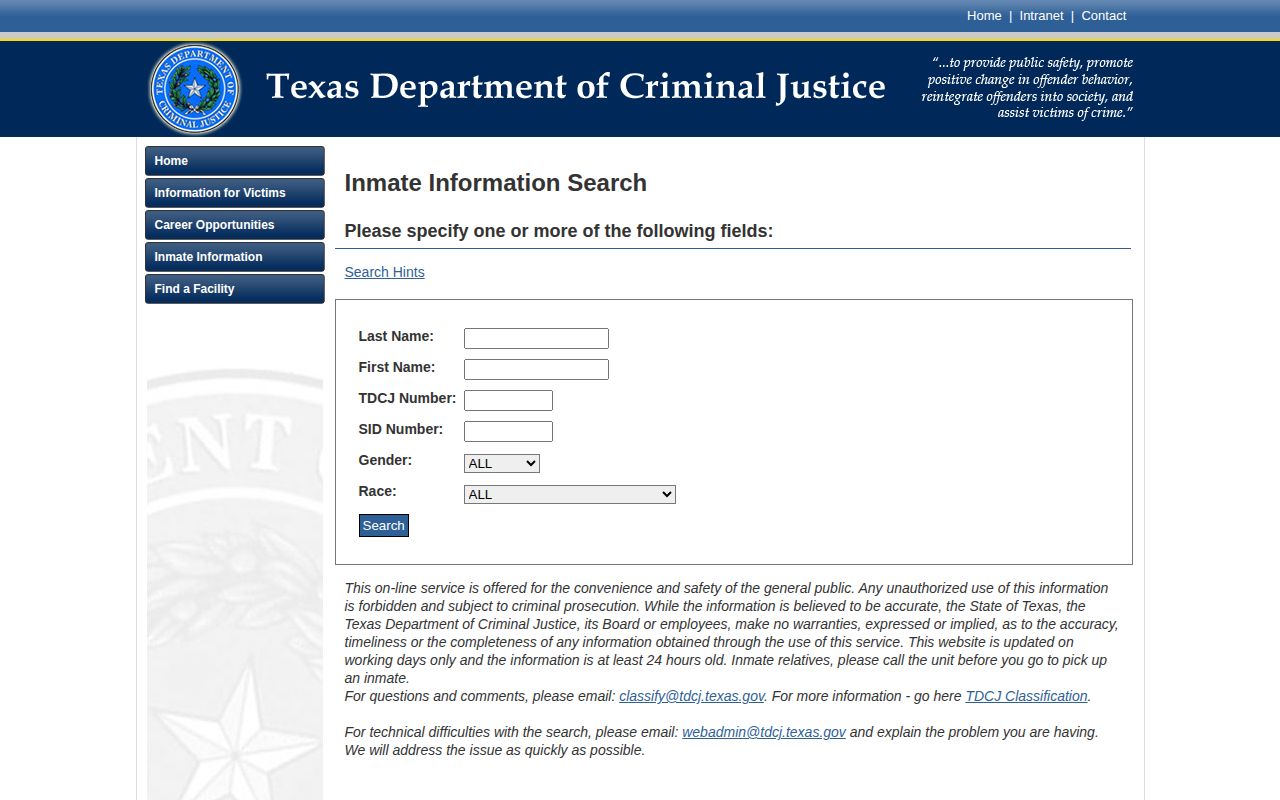
Once a person no longer appears, the no-fee history email and formal records channel are the durable TDCJ paths.
Check Recent Roberts County Jail Releases
The Roberts County Sheriff publishes neither a live inmate roster nor a 24-hour or 72-hour released archive. No public cadence, fields, booking-photo display, or retention window is stated. The practical substitute is a narrow date-range request for existing release-log lines, not a demand that the sheriff create a custom report.
Historical TCJS totals cannot identify people. The November 2021 housed-elsewhere report listed two Roberts inmates outside the county, and the 2022 snapshot recorded only aggregate releases. These dated reports show why “where was the person housed?” belongs in the call, but they do not establish anyone's present status.
Verify Roberts County Post-Release Supervision
Parole and mandatory supervision follow a TDCJ prison sentence and are administered by the TDCJ Parole Division. Probation, called community supervision in many Texas records, comes from a court order and may avoid prison or follow a suspended sentence. Neither status should be inferred from a jail release.
TDCJ assigns Roberts County to the Amarillo District Parole Office, Region V, at 5809 S. Western Street, Suite 120, Amarillo, 806-355-9218. An individual's release certificate controls reporting instructions. Court probation details come from the sentencing record and supervising department; sealed operational details may not be public.
Roberts Release Alerts and Federal Checks
Texas replaced its county VINE channel with Texas IVSS-Counties on September 1, 2025. Search by name or identifiers, verify the source and facility, and follow the live portal's registration steps. Not every county participates, and Roberts County coverage was not confirmed. TDCJ prisoners and parolees use a separate IVSS portal whose alerts can cover review, Board decisions, release, discharge, and supervision warrants.
The BOP Inmate Locator covers federal prisoners from 1982 onward and can retain a “Released” result with a date. “Not in BOP custody” does not rule out USMS, state, local, or immigration custody. ICE's locator can show current detainees and people released from ICE custody during the last 60 days. A county transfer to ICE is continued custody, while an ICE release addresses only the immigration-custody event.
Match Roberts Status to the Right Record
Each system has a defined scope. A negative result outside that scope proves little.
| System | Best use | Limit |
|---|---|---|
| Roberts County Sheriff | Local custody, housing destination, booking and exit event | No public roster or released feed |
| Combined county/district clerk | Bond, charge, judgment, dismissal, and discharge instruments | Legal event may differ from physical exit time |
| TDCJ search and records | Current state custody, projected dates, and historic incarceration | Online search is current-only |
| IVSS portals | Matching covered people and registering for status alerts | Portal result is not the official record |
| BOP locator | Sentenced federal custody and recorded federal release | Does not cover every federal or later custody stage |
| ICE locator | Current immigration detention and recent ICE release | Released history is limited and minors are excluded |
Roberts County Custody and Release Systems
The Facility Map includes the local jail operation and four escalation systems. Only the sheriff operation is local custody; the others explain what may happen after a transfer or state or federal sentence.
- Roberts County Sheriff's jail/holding operation: local booking, housing, transfer, and release records.
- Texas Department of Criminal Justice: statewide prison custody and release history; no TDCJ unit was identified in Roberts County.
- TDCJ Parole Division, Amarillo area: the regional supervision route for Roberts County parole and mandatory supervision.
- Federal Bureau of Prisons: sentenced federal custody and recorded federal release.
- ICE detention system: conditional immigration-custody checks when a detainer or transfer appears.